by Joe Seamons
“How and why did The Rhapsody Project get started?”
This is a question I am often asked as one of the co-founders and current co-directors of our growing community organization, and it is high time we offer a little backstory on how this project came to be.
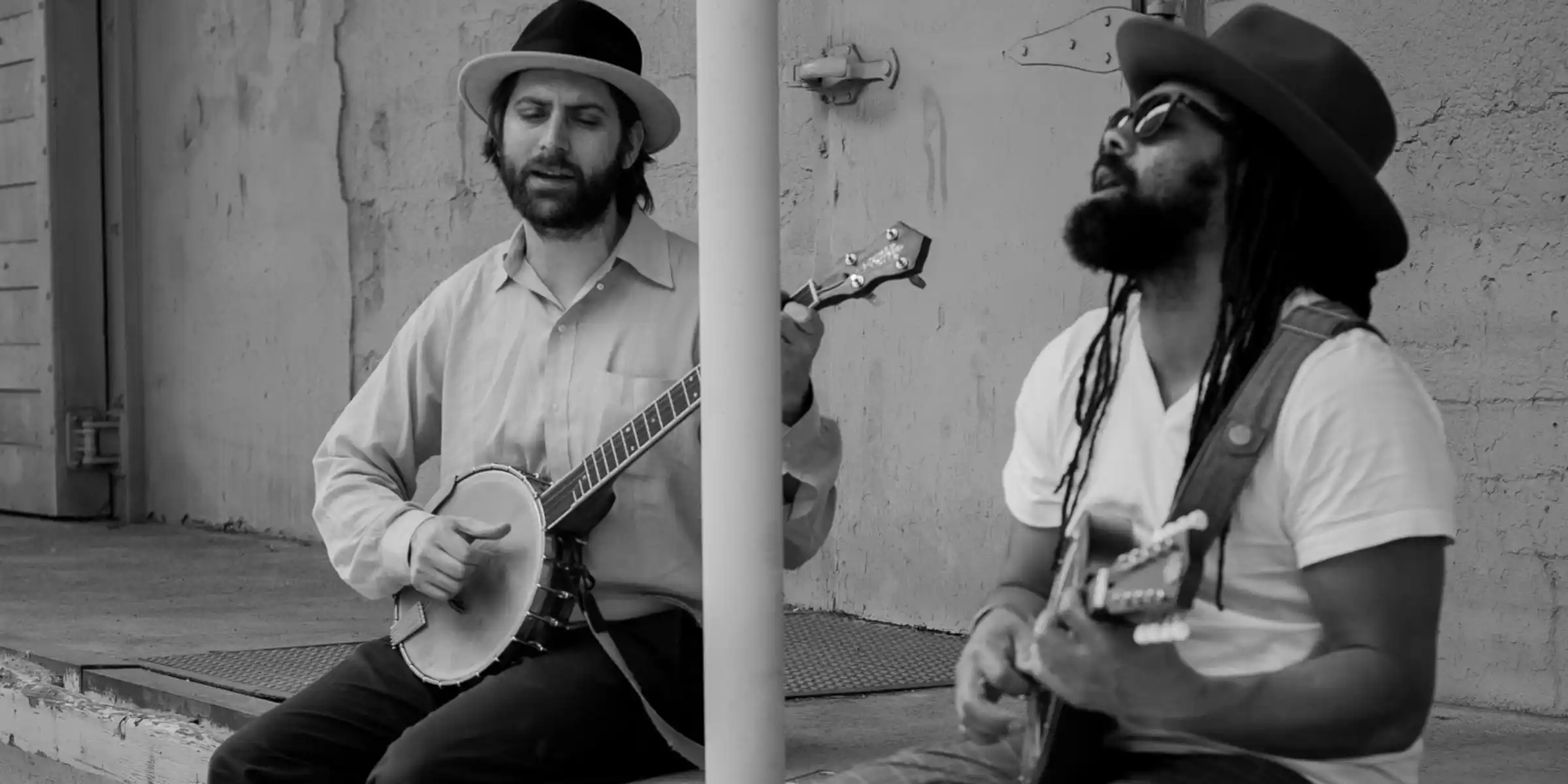
Way back in 2013, I was playing and touring as a part of Renegade Stringband when someone reached out to our band and asked if we wanted to present some music to students at a local school in Seattle. So, I asked my band, and my bandmate Ben Hunter responded with an enthusiastic “let’s do it,” and then responded with similar commitment a few months later when I invited my bandmates to join me at the Pt. Townsend Acoustic Blues Festival. Through these experiences, Ben and I discovered that both of us were deeply committed to touring, teaching, and delving into the culture and stories of roots music.
As we developed what we could present together in schools (both of us had done a range of teaching gigs in various contexts before this), Ben proposed that we make the teaching work into a new, musical arm of his young non-profit, Community Arts Create. We named it “The Rhapsody Project” because all of the various definitions of “rhapsody” seemed to fit what we were all about. Namely:
- an effusively enthusiastic or ecstatic expression of feeling.
In Music: a free instrumental composition in one extended movement, typically one that is emotional or exuberant in character. - (in ancient Greece) an epic poem, or part of it, of a suitable length for recitation at one time.
Even the archaic Greek sense of the word tipped people off to our tendencies to be overly ambitious and rather verbose.
Like the definitions of the term, the motivations behind why we wanted to do the work were many:
First, we wanted young people to receive the musical education that we wished we had had – where the learning takes place in community, within culture, in a relaxed (rather than a formal) setting, and as much through osmosis as instruction. This type of learning was much more aligned with ways in which American music was developed – through a synthesis of cultures exchanging different elements while people either worked or enjoyed themselves.
Secondly, it was painfully obvious that public education was built on a European model (and, as I was to learn from one of our current board members, Dr. Chris Mena, a deeply racist and assimilation-based model that, sadly, reflects the worst parts of American-ness). There HAD to be a better way to present music to young people, to invite them into playing the amazing – and, often, all-too-obscure – songs that formed the basis for so much of what we now simply call “American culture.”
Thanks to the aforementioned, traditional blues festival (which I’ll refer to now simply as “Blues Camp”) in Pt. Townsend, we gained a beautiful understanding and experience of what learning music COULD be. Sitting alongside luminaries like Phil Wiggins, Valerie Turner, Sunpie Barnes, Del Rey, Steve James, and Guy Davis at Blues Camp, we were invited in and taught to experience the music as an opportunity to connect, celebrate, party, and relax in one another’s company. That was the experience we needed to show our students.
Motivated by this shared understanding with Ben, I was convinced to leave behind my life down in Portland, Oregon (where I had spent the past six years since graduating from Lewis & Clark College, hustling gigs, and teaching guitar lessons in after-school settings) and move up to Seattle.
The Collaboratory
Ben invited me to join him in teaching an after-school program alongside him at Washington Middle School, but it was not this shred of income that really convinced me to leave behind the community I had built in Portland. What did it was the discovery of the community that existed at that time in South Seattle, where (I was shocked to learn, according to the 2010 census) there existed the second-most diverse population of people and cultures in America outside of the Bronx. A wonderful subset of those communities was working with Ben and his friends to establish a community center called The Hillman City Collaboratory.
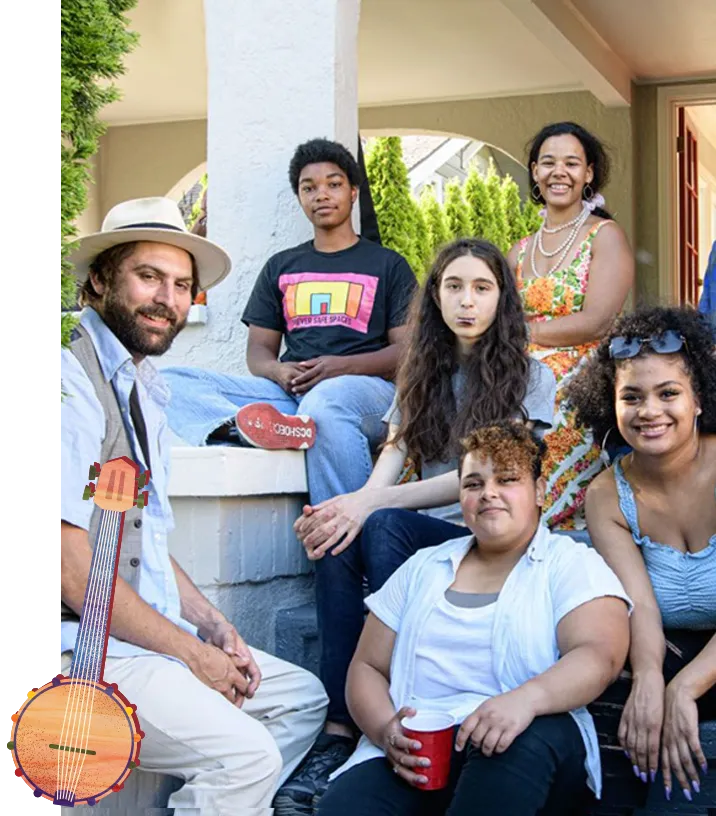
At “the Collab” we hosted jam sessions where our students could come with their families and play music for fun alongside all of our musician friends from across Seattle. We started featuring small concerts where touring bands or local musicians could perform, often with our students serving as the opening act, and we even did a couple of potluck events. Sometimes, other cool stuff would be happening at the Collab, and our students would be invited to provide the music.
Along about this time, I struck on the idea of giving an assignment to students to start talking to their families and community leaders to ask a simple question:
“What is our heritage?”
When the students came back with answers, we would point out the songs in our repertoire that reflected the heritage embodied by our students. When we did not have any such song, we would see if we could find a local artist who could come and teach (or, at the least, demonstrate) music or artistry from a culture that we were not the right people to teach. Unbeknownst to us, this approach was already a thing, termed “culturally responsive” pedagogy.
Part II coming soon! In the meantime, hear more from Joe and Ben directly at their show on Friday, February 20th at Black & Tan Hall.