
Written by Joe Seamons
What Is a Resonator?
A resonator can be an instrument and an idea. Innovators in the late 1920’s created a resonator – or resophonic – guitar using metal cones inside the body of the instrument to amplify string vibrations. This louder, brighter sound was first developed to make Hawaiian-style guitar playing louder, but was quickly adopted by jazz and blues musicians to make their guitars audible in dance halls alongside drums or horns before electric amplification was developed.
At The Rhapsody Project, a “Resonator” is a person whose recurring donations help us ensure access to programs and instruments for young musicians. When you Resonate with Rhapsody, you help young musicians widen their horizon, and stabilize our organization’s ability to support those young musicians with professional development training, free and discounted programs, and steady access to opportunities that foster a sense of rootedness and belonging.
Originally, resonators cut through the noise of dancers and revelry to keep the pulse of the music steady. In The Rhapsody Project, our Resonators keep our organization steadily serving the community.
A Short History of Resonator Guitars
In Hawaii, musicians had adapted the European instruments introduced by colonizers – especially ukulele and guitar – and developed their own unique style that eventually led to innovative guitar designs. According to Peter Blecha of History Link, landmark expositions hosted in Seattle and later in San Francisco were vital to these innovations:
“…it was in Seattle that the presence of Hawaiian musicians — especially Joseph Kekuku (1874-1932), the self-proclaimed inventor (ca. 1885) and early master of the Hawaiian-style steel guitar technique — had undeniable consequences. . . the [1909 Alaska-Yukon-Pacific Exposition] featured Joseph Kekuku who apparently intrigued enough fair attendees that he was swamped with requests to give lessons and as a result Kekuku reportedly stuck around town for a while to provide locals with steeling lessons.”
First, this influenced an important Seattle-based luthier, Chris J. Knutsen, who began building and selling Hawaiian-style guitars (built of Koa wood, and including hollow necks to be more resonant) immediately in the wake of the 1909 Exposition. By the mid-1910’s, Hawaiian music was developing into a nationwide craze, and blues musicians in the Southern United States began hearing “steel guitar” (so called because the musicians would fret the strings with a steel bar) played on the radio. They began imitating the keening, voice-like effect of this sound with everything from glass bottle necks to knifeblades.
But, as bands grew larger, the world grew louder, and it became difficult to hear the music – whether it was Hawaiian steel guitar or bottleneck slide in a Mississippi delta juke joint – over the din.
Why Resonators Matter in Music History
Into this problem of volume walked a Slovak immigrant in California named John Dopyera. He ran a small instrument shop in Los Angeles, fixing violins, building banjos. An American musician who performed Hawaiian music, named George Beauchamp, came to Dopyera with a challenge: make this guitar loud enough to be heard.
Dopyera looked at the problem the way Thomas Edison had looked at sound itself — and his answer was three hand-spun aluminum cones, nested inside a gleaming brass body, vibrating like speakers without a single wire or battery.
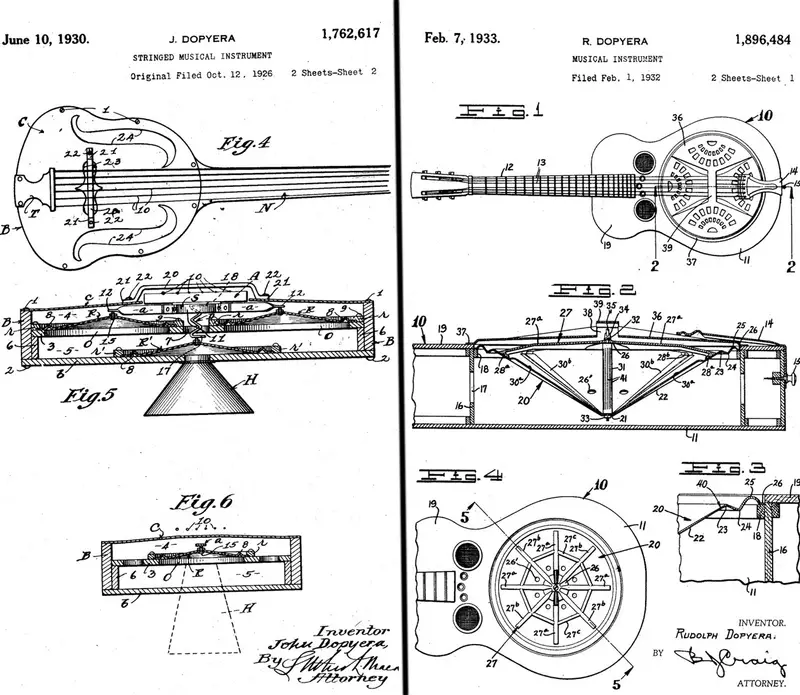
This was the first mechanical amplification of a guitar before electric guitars were developed with vital also work by Beauchamp – as well as another Seattle-based musician, Paul H. Tutmarc, who taught Hawaiian “steeling” style guitar and performed with his band the Islandaires. According again to Historylink:
“Tutmarc had designed one of the world’s very first electromagnetic pick-up devices and his Audiovox Manufacturing Company proceeded to build and market various electric instruments which are now acknowledged by historians as important pioneering contributors to the rise of electric guitars in general “
Thus, like the tangled history of blues and gospel music – created by Black Americans and spreading into so many branches of American culture – the development of unique, culturally rooted music by Hawaiians led to the creation of both the acoustic amplification of resophonic guitar and, in turn, electric amplification of the guitars that are now iconic, and essential to the sound of many genres of American music.
Why This Story Matters Now
At The Rhapsody Project, we use music to help people explore their heritage, build community, and foster cultural equity. Our programs are rooted in the belief that music is not just something people consume; it is something people inherit, practice, repair, and pass on. By knowing the true history of our country’s music, we are enriched and fed by the beautiful gumbo of cultures that used music as a form of resistance, a source of resilience, and a vehicle to preserve their cultural knowledge and traditions.
This is why our non-profit’s community of Resonators is vital: when you help sustain our work over time through recurring support, this makes it possible for us to keep teaching, gathering, and building programs that center those living furthest from access, and rooting young people in multi-generational learning.
Join the Resonator Community
When you become a Resonator, your recurring gift helps amplify young people’s voices, talents, and experiences while strengthening the long-term health of our programs. If this history of the resonator speaks to you, we invite you to help carry that amplification forward by joining us in community.